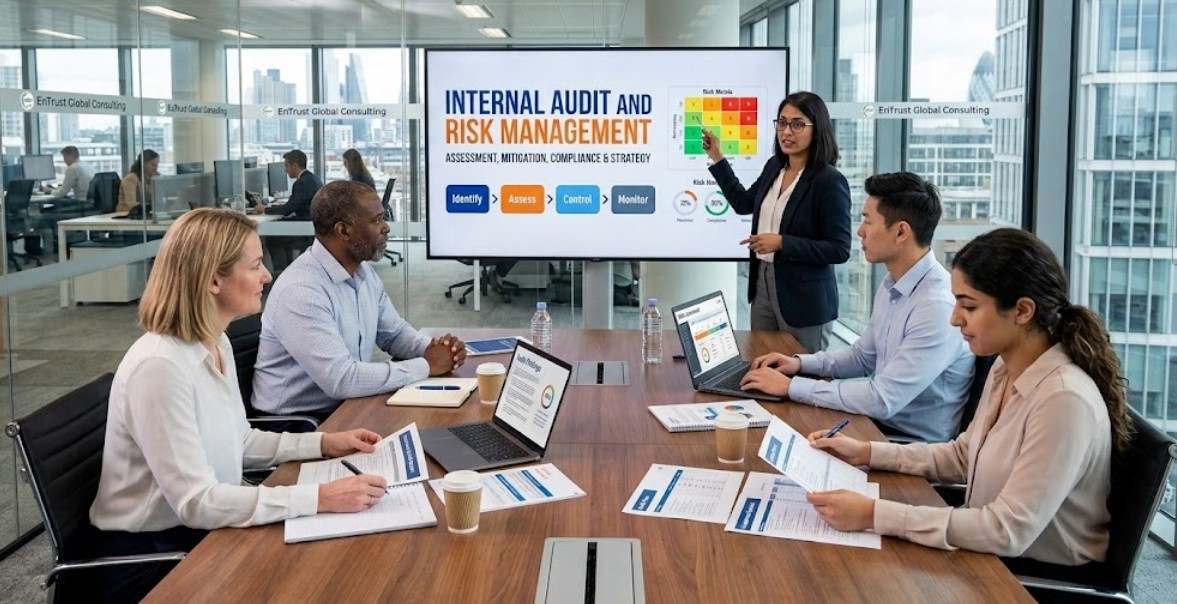
Regulators, lenders and boards now expect clear evidence that a business understands its risks and controls them. In the UAE, the introduction of corporate tax and growing compliance obligations have made that evidence harder to improvise.
This is why internal audit and risk management have moved from back-office routines to board-level priorities. The two functions are often confused. They protect the same business objectives but do different jobs.
This guide explains each one, shows where they connect, and gives you practical tools to assess your own setup.
Internal audit is an independent, objective function that evaluates how well an organization manages governance, risk management and internal controls. Auditors review processes, policies and systems, then recommend improvements. Their findings go to senior management and the audit committee.
Its main purpose is to find weaknesses that could stop the business from reaching its goals. Auditors test whether controls work in practice, not just on paper.
Typical audit areas include:
Financial reporting and close processes
Procurement and vendor payments
Inventory and asset management
IT systems and cybersecurity
Regulatory compliance
Human resources and payroll
Institute of Internal Auditors publishes the Global Internal Audit Standards, which set the professional benchmark for independence, objectivity and quality.
Risk management is the process of identifying, assessing, responding to and monitoring events that could affect an organization’s objectives. It gives management a structured view of exposure. The goal is informed decisions, not zero risk.
Risks come from many sources: financial losses, supply chain disruption, cyber threats, regulatory change, equipment failure, fraud and market shifts.
A basic cycle has four steps: identify the risk, assess its likelihood and impact, choose a response, and monitor for change. ISO 31000 and the COSO Enterprise Risk Management framework describe this cycle in detail.
Every risk gets one of four responses:
Reduce it with controls
Transfer it through insurance or contracts
Accept it within a defined appetite
Avoid it by changing the activity
Risk management identifies and manages risks, while internal audit independently checks whether risk processes and controls are effective. Management owns the risks. Internal audit provides assurance about them. The two functions share information but must keep separate responsibilities.
Take cybersecurity as an example. Management identifies it as a major risk and puts access controls, security policies, staff training and monitoring in place. Internal audit then tests whether those controls are well designed and operating effectively.
This split is often described through the Three Lines Model:
First line: operational managers own and manage risk.
Second line: risk and compliance teams set frameworks and monitor.
Third line: internal audit provides independent assurance.
Keeping these lines distinct protects auditor independence. An auditor who designs a control cannot objectively assess it later.
A risk-based internal audit has five stages: risk assessment, audit planning, fieldwork and testing, reporting, and follow-up. Each stage feeds the next. The approach prioritizes high-risk areas instead of treating every process equally, so audit effort goes where it adds the most value.
The process starts by identifying significant risks. Auditors score areas by likelihood, potential impact, regulatory exposure, operational complexity and the strength of existing controls.
Those scores shape the audit plan. High-scoring areas get audited more often and in more depth. Lower-risk areas are reviewed on a longer cycle.
During fieldwork, auditors gather evidence. They review documents, interview employees, analyze transactions, observe activities and test samples. The aim is to confirm that controls are properly designed and operating as expected.
The audit report then sets out each weakness, its potential impact and a recommended fix. Clear reporting helps management respond quickly.
Follow-up closes the loop. Auditors check that agreed actions were actually completed. A finding without follow-up is only a recorded problem.
Internal controls are policies, procedures and activities that help an organization achieve its objectives and manage risk. Strong controls reduce errors, discourage fraud, improve financial accuracy and support compliance. Auditors assess whether each control fits the risk it is meant to address.
Common examples include approval procedures, segregation of duties, access restrictions, reconciliations, inventory counts and management reviews. The COSO Internal Control Framework is widely used to structure them.
Weak controls usually show up in the same places. A single person can create and approve a payment. User access is never reviewed after staff leave. Reconciliations are done late or not at all. Those patterns are exactly what an audit is designed to catch.
Rate any control on this four-level scale before an audit begins:
Ad hoc: done inconsistently and dependent on individuals.
Documented: a written procedure exists but is not always followed.
Operating: followed consistently, with sign-offs and logs.
Monitored: tested regularly with metrics and escalation.
Most findings cluster at levels 1 and 2. Moving a critical control to level 3 is usually the best first investment.
Not sure where your controls sit on this scale? Our team can walk you through structured risk and audit services to map priorities before an audit begins.
A combined approach gives management better risk visibility, stronger controls, improved compliance and clearer decisions. Regular assessments surface emerging threats early, while independent audits confirm that responses work. The result is less surprise and more confidence in reported information.
Better risk identification: regular assessments catch emerging threats before they escalate.
Stronger controls: audits expose gaps and recommend fixes.
Improved compliance: policy and regulatory reviews reveal weaknesses early.
Better decisions: reliable risk data gives management a clearer view of challenges.
Greater efficiency: audits can uncover duplicated activities and wasted resources.
The most common challenges are outdated risk information, treating audit as a compliance exercise, and blurred responsibilities. Each one reduces the value of the function. Addressing them early keeps the program credible with management and the board.
Outdated risk data. Technology, regulation, market conditions and growth all change risk quickly. A register updated once a year will miss most of it.
Compliance-only thinking. An effective audit function also asks how risks and controls affect wider business objectives.
Blurred ownership. Internal audit should not manage risks. Management stays accountable for risk decisions, and auditors stay independent.
Is the risk register reviewed at least quarterly?
Are audit findings tracked to closure with owners and dates?
Does internal audit report to the audit committee, not only to finance?
Is the audit plan based on documented risk scores?
Are control owners clearly named?
Two or more “no” answers suggest the framework needs attention.
Yes, for most organizations beyond the smallest. Risk management helps you decide what to protect and how, and internal audit checks that those protections work. Together they improve oversight, reduce avoidable losses and support credible reporting to owners, lenders and regulators.
How much you need depends on your size and risk profile. A small company may start with a basic risk register and an annual controls review. A growing or regulated business benefits from a formal, risk-based audit plan and an independent reviewer.
If your risks, systems or regulatory obligations are changing, now is a sensible time to review your setup.
For UAE businesses reviewing their approach, EGC Consulting supports organizations with structured internal audit, financial controls, compliance and risk assessment. Contact our team to discuss which areas may need review or improvement.
Risk management identifies, assesses and responds to risks, and management owns it. Internal audit independently evaluates whether risk management processes and controls work. One manages risk, the other gives assurance about how well it is managed.
Frequency depends on risk. High-risk areas such as financial reporting, IT security and compliance are often reviewed annually or more often. Lower-risk areas can follow a two or three year cycle. A risk-based audit plan sets the schedule.
It is not recommended. Internal audit must stay independent and objective, which is difficult if the auditor also makes risk decisions. Small businesses sometimes outsource internal audits to a third party to preserve independence.

Your trusted partner for strategic advice and managed services in Finance, IT and Tax Excellence.
© 2025 EnTrust Global Consulting. All Rights Reserved.